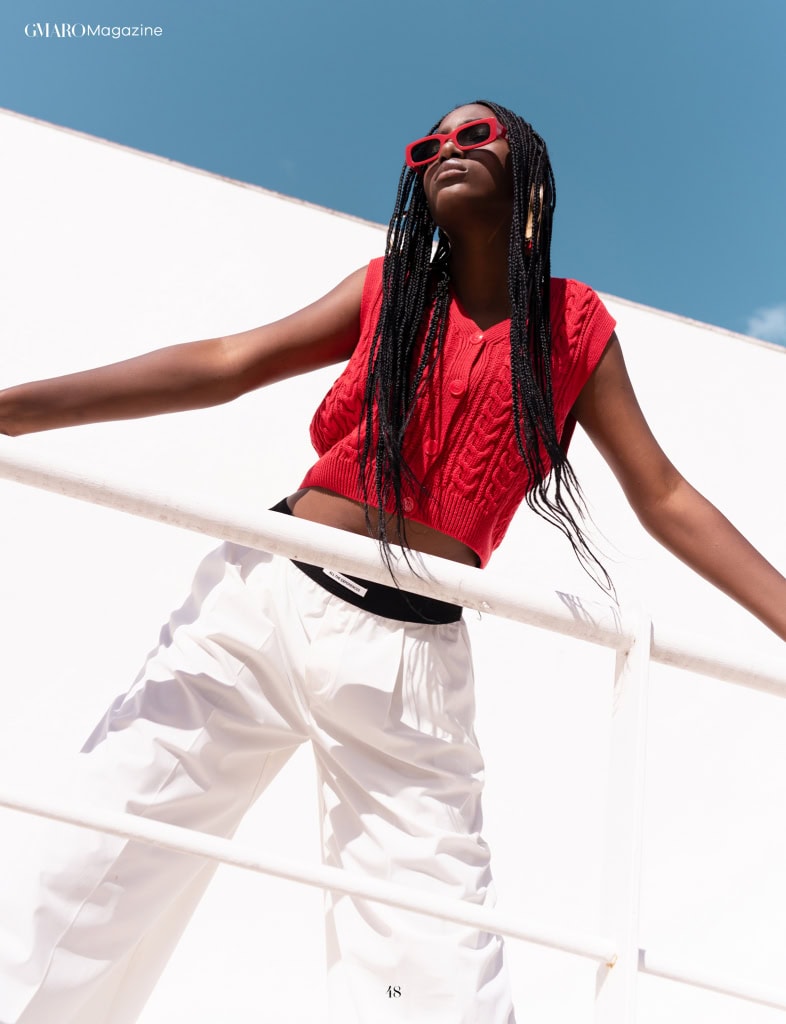
Every photographer reaches a point when they want to see differently. It’s a natural part of growing in this work, and I’m always looking for new ideas. I’m now based in Miami, but the photographs I made during my years in Lisbon and Portugal are still part of that exploration. Here I share five ways I use cropping, angles, color, a wide lens, and movement in my editorial fashion photography.
1. Crop with a clear purpose
Cropping is one of the simplest ways to see a familiar photograph differently. Take a finished image and try several versions: what happens if you move closer, remove a distracting edge, or leave more space around the person? In the Lisbon example shown here, the original is on the left and the tighter crop is on the right. The change directs attention more clearly toward the subject. This photograph also appeared on PhotoVogue, something I was very happy to see.
A tighter crop helps when it strengthens the expression or removes something unnecessary. It can work against you when it cuts away an important clothing detail, an intentional gesture, or the space needed for a final layout. The available resolution matters too. I want the crop to serve the photograph and its intended use, rather than simply make it tighter.


2. Change the camera angle
At a master class, I heard a photographer give a piece of advice that stayed with me: show something familiar from a viewpoint the eye doesn’t usually see. A lower position, a higher view, or a small change in distance can alter the whole image. When I photograph an editorial, I really do dance around the model, and she moves too. I might take a series of frames to catch one split second, or study a reference and build a particular composition. I prefer the first approach because it gives my own ideas more room.
My brand clients often ask for a few more experimental images alongside the clear photographs of their products. I like that balance. An unusual angle can bring energy and character while still showing the item clearly.


3. Use color to shape the mood
Color can make even a simple photograph feel very different. I can spend several hours choosing the right hue and tone, because it changes how I read the image. For a brand, I first think about the real appearance of the product. Clothing, shoes, accessories, and jewelry should not become a different color simply because I like the effect. We discuss the visual direction and any requirements for showing the products accurately.
An editorial can give me more freedom to build an unusual color world. Often, I am already imagining that world while planning the location, light, clothes, and makeup. The most useful color choice brings those parts together. It becomes a distraction when it overwhelms the person, changes the product misleadingly, or looks unrelated to the rest of the series.


4. Explore a wide-angle lens
When I began working with a wide-angle lens, it changed the way I saw the frame. It can bring in the surroundings, exaggerate a line, or make the distance between the camera and the model feel more active. I use it for both portraits and full-length fashion images, especially in editorials where I have room to experiment. The series shown here comes from that side of my work.
There is also a risk of distortion, particularly when I move very close or place a face or body near the edge of the frame. That may be an intentional part of a fashion image, or it may work against the person and the clothes. A wide lens is not forbidden in a more natural photograph; it simply needs a clear purpose and careful attention to position and distance.


5. Bring movement into the frame
Sometimes a series has beautiful poses but very little movement. One easy place to start is walking. I can stay in one position while the model moves and I change my angle. I can move with her. Or we can both move more freely and see what happens between the planned frames. I particularly enjoy a tilted horizon with an active movement, because it can make the photograph feel caught in the moment.
Movement helps when it adds a gesture, rhythm, or feeling that the series is missing. It can get in the way if the important detail is hidden, the product becomes difficult to read, or the image is blurred in a way we did not intend. I still make the clear photographs the project needs. Then we can give ourselves room to play.
How to use these ideas when planning your shoot
You do not have to tell me which lens to use. If one of these examples speaks to you, show me what you like about it: the energy, the close crop, the space, the color, or the movement. A small selection of references is often more useful than a long list. Tell me where the images will be used as well, because a beautiful effect should still leave room for what your photographs need to do.


I hope these five ideas give you something new to notice in a photograph, or a starting point for your own series. If you would like to explore a more expressive shoot in Miami, tell me what caught your eye. We can talk about your brand, a personal fashion story, or a direction you have not tried before. I would love to hear your ideas💛
Author: Julia Yatel